
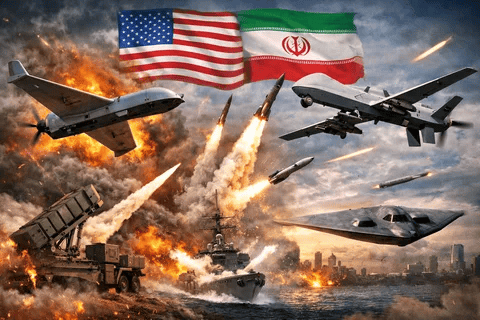
The confrontation between the United States, Israel, and the Islamic Republic of Iran represents a profound structural rupture in the modern geopolitics of the Middle East. What began decades ago as an ideological cold war born out of the 1979 Iranian Revolution has evolved through proxy escalations, economic maximum pressure campaigns, and cyber warfare into open military conflict. This escalation has rewritten the security architecture of the Gulf and reshaped global economic stability.
The Road to Escalation
The friction points underpinning the current hostilities accumulated over decades. Following the U.S. withdrawal from the Joint Comprehensive Plan of Action (JCPOA) in 2018, Washington pursued a strategy of severe economic strangulation against Tehran. In response, Iran accelerated its nuclear enrichment activities and relied more heavily on its “Axis of Resistance”—a network of regional proxy forces spanning Lebanon, Iraq, Yemen, and Syria.
Regional flashpoints following the outbreak of the Israel-Hamas war in late 2023 pushed the adversary states closer to a direct collision. The collapse of subsequent diplomatic frameworks and the failure to secure a renewed nuclear agreement left little room for political de-escalation.
The Military Phase and Strategic Realities
When major hostilities erupted, joint U.S. and Israeli air campaigns targeted core military assets, air defenses, command nodes, and nuclear infrastructure. The operations delivered severe blows to Iran’s military apparatus and leadership structure, fundamentally altering its capacity to project conventional power across the region.
Despite the overwhelming technological and air superiority wielded by the coalition, the conflict laid bare the immense challenges of modern asymmetric warfare. Rather than forcing a total political capitulation, initial strikes triggered localized retaliations, dynamic missile exchanges, and persistent flashpoints surrounding critical maritime chokepoints like the Strait of Hormuz. Iran’s surviving command infrastructure demonstrated a capacity for decentralized operations, ensuring that the conflict remained protracted and deeply volatile.
Global and Regional Fallout
The shockwaves of the war extended far beyond the immediate battlefields, sending tremors through the international economy. Critical energy infrastructure, shipping lanes, and global supply chains experienced unprecedented disruptions, triggering severe market volatility and forcing neighboring Gulf Arab states to navigate an intensely precarious security landscape. For states in the region, the war highlighted the profound risks of protracted instability and the heavy cost of unconstrained escalation.
Diplomatic efforts—including temporary ceasefires and mediated talks—have repeatedly struggled to secure a permanent peace. The persistent friction over maritime transit, nuclear compliance, and regional security guarantees means that any temporary lull in fighting often proves fragile.
Conclusion
The conflict between the United States and Iran serves as a stark reminder of the limits of military coercion in resolving deep-seated ideological and geopolitical feuds. By inflicting systemic damage without yielding a clear political endgame, the hostilities have left the region trapped in a tense cycle of strategic recalibration. Ultimately, the long-term resolution of this historic standoff will depend less on fleeting military dominance and more on whether a durable diplomatic framework can eventually reconcile regional security with Iranian sovereignty.

Leave a Reply